Eminent domain
Texas Pipeline Easement: What a Company Can Ask For, Your Rights as a Landowner, and How Compensation Works
What a Texas pipeline easement allows, when a company can condemn, the offers and Bill of Rights it must give you, and how compensation is measured.

Counselado · August 19, 2026 · Texas · Updated October 1, 2026
A Texas pipeline easement is a legal right to use part of your land for a pipeline and the work that goes with it, such as building, inspecting, repairing and maintaining the line. A company can ask you to grant one voluntarily. Whether it can condemn the easement if you say no depends on how the company and its pipeline are classified under Texas law, and the Railroad Commission says a T-4 permit alone does not decide that question. If condemnation goes forward, Texas Property Code chapter 21 (opens in a new tab) sets the offers, disclosures, hearing and compensation rules, and compensation is measured by valuation rules rather than a set rate.
Key takeaways
- A pipeline company can ask for a voluntary easement; condemnation authority depends on its legal classification and statutory authority.
- The Railroad Commission of Texas describes the T-4 as an operating permit, not a ruling on whether a company may condemn land.
- Before condemning, the company must make an initial offer and a final offer at least 30 days later, with appraisal disclosures and the Landowner's Bill of Rights.
- If there is no agreement, three special commissioners assess damages, and either side can object and take the case to trial.
- Compensation covers the market value of the interest taken and qualifying damage to the rest of your property, measured for your tract.
- Easement terms such as width, number of lines, substances, access, assignment, restoration and abandonment are spelled out in the document you are asked to sign.
A company contacted you about a pipeline easement. What does that mean?
An easement does not transfer ownership of your land. It gives the company a right to use a strip of it for the purposes the document lists. Texas A&M AgriLife Extension's Texas Pipeline Easement Negotiation Checklist (opens in a new tab) (December 7, 2021) describes the usual rights requested: to construct, operate, inspect, maintain, repair, replace or remove one or more pipelines.
The first contact is often a letter, a request to survey the land, or an offer. Two very different paths can follow. In a voluntary easement, you and the company agree on terms and payment, and you sign. In condemnation, also called eminent domain, a company with legal authority asks a court to take the easement and pay compensation set through a hearing. The Texas Constitution, article I, section 17 (opens in a new tab) requires that private property be taken only for public use and with adequate compensation. For the general rules that apply to any taking, our guide to Texas eminent domain and landowner rights walks through the whole process, and what eminent domain means covers the basic terms.
A survey request is its own question. Permission to enter and survey is separate from authority to condemn, so it helps to ask the company in writing what legal basis it relies on for entry and who pays for any damage the survey crew causes.
Does the company have authority to condemn your land?
Authority depends on what kind of pipeline it is and what it carries. Texas law gives condemnation power to several categories of pipeline operators, and a company that is simply a private line serving itself does not gain that power just by operating a pipeline.
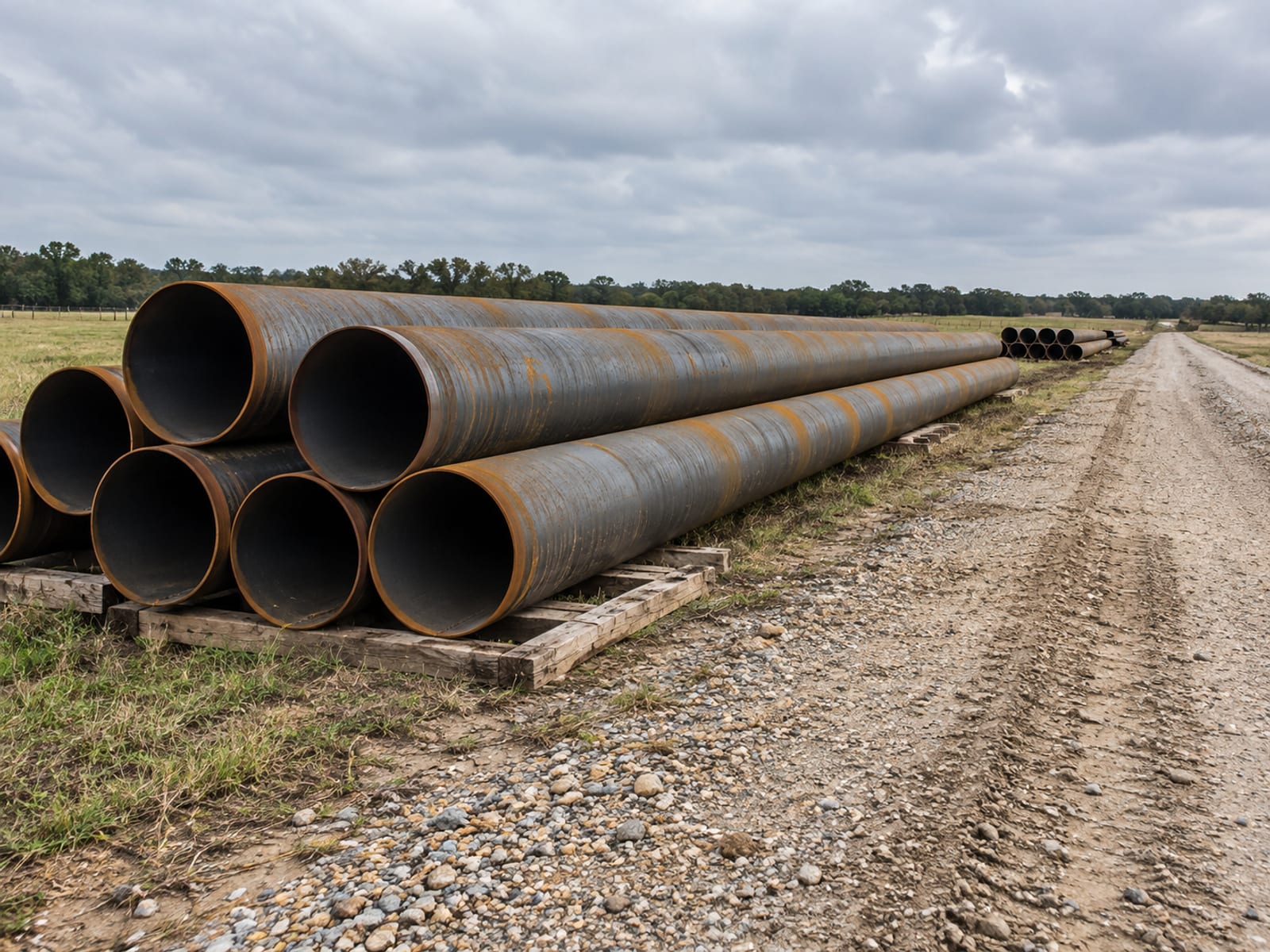
- Common carriers. Natural Resources Code section 111.002 (opens in a new tab) defines common carriers, including qualifying crude petroleum pipelines that transport to or for the public for hire, and section 111.019 (opens in a new tab) gives common carriers the power of eminent domain.
- Gas utilities. Utilities Code section 101.003 (opens in a new tab) and section 121.001 (opens in a new tab) govern gas utility classifications and their powers.
- Certain other entities and products. Business Organizations Code section 2.105 (opens in a new tab) provides condemnation authority for qualifying entities and products.
Courts, not the Railroad Commission, decide whether a particular pipeline qualifies. In the Texas Rice Land Partners v. Denbury Green Pipeline-Texas litigation (2012, and again in 2017 (opens in a new tab)), the Texas Supreme Court held that a pipeline claiming common-carrier status must establish the statutory public-use basis for that status. In Hlavinka v. HSC Pipeline Partnership (2022) (opens in a new tab), the court held that Business Organizations Code section 2.105 supplied condemnation authority for the pipeline in that case and treated public use as a legal question on the undisputed record.
The T-4 permit is where many landowners start, and it is useful, but it has limits. The Railroad Commission's pipeline eminent domain and condemnation FAQ (opens in a new tab) explains that a T-4 is a permit to operate a pipeline in Texas and that the classification on it does not itself decide condemnation authority. The Commission also states that it does not administer eminent domain or private property rights law. A practical step is to ask the company which statute it relies on, then compare that answer with its T-4 record.
What the Landowner's Bill of Rights and the offers must include
Texas requires a specific paper trail before a condemning entity can file suit. Government Code section 402.031 (opens in a new tab) directs the Attorney General to publish a Landowner's Bill of Rights covering notice of the proposed acquisition, good-faith negotiation, assessment of damages, the hearing, appeal rights, complaints about registered easement or right-of-way agents, and the owner's options. The current English version (opens in a new tab) is marked REV 11/25, and a Spanish version (opens in a new tab) is also available.
Under Property Code section 21.0112 (opens in a new tab), the entity must give you the Bill of Rights no later than the seventh day before its final offer, and also before or at the same time it first tells you it has eminent domain authority. The offer rules come next.
Hover or tap a row to highlight it.
| Step | What the law requires | Source |
|---|---|---|
| Initial offer | A written initial offer to acquire the property | § 21.0113 (opens in a new tab) |
| Appraisal disclosure | Qualifying appraisal reports prepared in the preceding 10 years, subject to statutory conditions | § 21.0111 (opens in a new tab) |
| Bill of Rights | No later than the 7th day before the final offer, and before or when authority is first claimed | § 21.0112 (opens in a new tab) |
| Certified appraisal | Obtained before the final offer, covering the property taken and any damage to the remainder | § 21.0113 (opens in a new tab) |
| Final offer | At least 30 days after the written initial offer, equal to or more than the written appraisal | § 21.0113 (opens in a new tab) |
| Time to respond | At least 14 days to respond to the final offer | § 21.0113 (opens in a new tab) |
Keep every letter, offer, appraisal and envelope with its date. Those dates are how you or a lawyer can check whether each step happened in the required order.
What the easement document can allow
The easement document controls what the company can do on your land for as long as it lasts, so its wording matters as much as the payment. For covered private-entity pipeline easements, Property Code section 21.0114 (opens in a new tab) requires the conveyance instrument to address applicable terms, including:

- the maximum number of pipelines and the initial pipeline diameter;
- the category of substances that may be transported;
- aboveground equipment and facilities;
- a location description, plat or map, and the maximum easement width;
- the initial pipeline depth and double-ditching;
- limits on assignment and on third-party access;
- rights to construct, operate, inspect, maintain, repair, replace and remove the line.
Other terms remain open to negotiation. The AgriLife checklist lists common subjects landowners raise, such as route and width, number of lines, permitted uses, damages, construction, restoration, access, future use, assignment and abandonment. The Attorney General's Bill of Rights adds an addendum explaining which terms are required and which an owner may negotiate. Useful questions for any draft: is the easement permanent or temporary, can the company add future lines, how will fences, roads, drainage, crops and timber be handled, and what happens if the pipeline is abandoned?
What happens if you do not agree
If the offers do not lead to an agreement, the entity can file a condemnation petition under Property Code section 21.012 (opens in a new tab). Venue follows section 21.013 (opens in a new tab), which generally places the case in the county where the property is located, subject to a rule tied to the owner's residence.
The judge then appoints three disinterested property owners from the county as special commissioners, plus alternates, no later than the 30th calendar day after filing under section 21.014 (opens in a new tab). The hearing cannot take place before the 20th day after appointment under section 21.015 (opens in a new tab), and notice must be served at least 20 days before the hearing under section 21.016 (opens in a new tab). At the hearing, the commissioners hear evidence and assess damages.
The award is not the last word. Under section 21.018 (opens in a new tab), a party can file written objections on or before the first Monday following the 20th day after the commissioners file their findings. A timely objection sends the case to trial as an ordinary civil case. Without one, the court adopts the commissioners' findings under section 21.061 (opens in a new tab). Because that objection window is short, track the date the findings are filed as soon as you learn of it.
Texas condemnation steps after the offers
- Petition filedThe entity files a condemnation petition under section 21.012, generally in the county where the property is located.
- Commissioners appointedThe judge appoints three special commissioners, plus alternates, no later than the 30th calendar day after filing.
- Hearing noticeNotice must be served at least 20 days before the hearing, which cannot take place before the 20th day after appointment.
- Hearing and awardThe commissioners hear evidence, assess damages and file their findings.
- ObjectionsA party may file written objections on or before the first Monday following the 20th day after the findings are filed.
- Trial or adoptionA timely objection sends the case to trial as an ordinary civil case; without one, the court adopts the findings.
How compensation is measured
Property Code section 21.042 (opens in a new tab) requires the special commissioners to assess adequate compensation for the property acquired. When only part of a tract is taken, which is the usual situation with a pipeline easement, the assessment also includes the effect on the remaining property. In practice, the valuation looks at:
- the market value of the property interest taken;
- injury to the remaining property caused by the taking and the public use;
- benefits to the remainder, where the statute allows them to be considered;
- qualifying improvements and uses;
- damage tied to temporary construction or workspace areas, when those interests or the resulting property damage are part of the acquisition and the evidence.
Damage to the remainder is generally measured by comparing the market value of the remaining land immediately before and immediately after the taking, considering improvements and how the strip taken will be used. In Hlavinka, the Texas Supreme Court held that arms-length sales of pipeline easements could be relevant evidence of highest and best use and market value. That ruling is about what evidence a court may consider; it does not set a price for any other property. The underlying court of appeals opinion (opens in a new tab) in the same case shows temporary workspace, crop and surface damages as separate parts of that award, which illustrates the categories involved rather than a figure to expect.
No statewide payment rate applies to Texas pipeline easements, so the value of a particular easement comes from the property, the interest taken and the evidence. A certified appraisal of your own tract, together with the appraisals the company must disclose, gives you something specific to compare against the offer.
If you own with others, lease the land or own minerals
A pipeline easement can affect more than one person's rights in the same land. Chapter 21 requires the petition to identify known owners and gives notice and participation rights to parties in the proceeding, and the commissioners assess damages owed to the property interests presented to them.

Co-owners, tenants with leasehold, crop or possession interests, mineral owners, spouses and lienholders can each have a stake, and an easement signed by the surface owner does not automatically settle those other rights. How compensation is divided depends on the title, leases, existing instruments, the interest acquired and the evidence, so list every owner, tenant, mineral interest, spouse and lender early and have the documents reviewed together.
Which agency regulates the pipeline
The Railroad Commission's pipeline safety division (opens in a new tab) regulates specified intrastate pipeline safety and permitting matters, including intrastate natural gas and hazardous liquid transmission, gathering and distribution systems. Interstate pipelines generally fall under federal jurisdiction instead.
The Commission's records can help you identify who you are dealing with. A T-4 record shows the operator, product, counties, mileage, physical characteristics and requested classification. You can use the T-4 permit search instructions (opens in a new tab), the pipeline reports page (opens in a new tab), the Public GIS Viewer guidance for locating pipelines (opens in a new tab), the list of active common-carrier pipeline tariffs (opens in a new tab), and the gas utility FAQ (opens in a new tab) for gas utility questions.
What changed recently in Texas law
The 2021 reforms in HB 2730 took effect January 1, 2022, adding or revising offer, disclosure, conveyance-term and procedure requirements, including section 21.0114. HB 2011 (opens in a new tab) took effect September 1, 2025, and amended chapter 21's repurchase provisions, including landowner information requests beginning on the tenth anniversary of an acquisition. A separate 2025 bill, SB 292, would have required the Bill of Rights with the initial offer and added survey-access disclosures, but its official bill history (opens in a new tab) shows it was left pending in committee, so the current chapter 21 text still controls. If your acquisition started before 2022, ask which version of chapter 21 applied on your offer dates.

Finding a lawyer, an appraiser and official records
A condemnation lawyer can review the company's authority, the offers, the easement terms and your deadlines, and an appraiser can value your specific tract. The State Bar of Texas Lawyer Referral and Information Service (opens in a new tab) takes statewide requests at 800-252-9690. The State Bar says the service offers an initial consultation of up to 30 minutes for no more than $20, and any later fee is agreed between you and the lawyer. TexasLawHelp (opens in a new tab) lists free and low-cost resources and referral information. Our overview of how to find a lawyer explains how to check a license and what to ask at a first meeting.
Check what you know about Texas pipeline easements
Frequently asked questions about Texas pipeline easements
Landowners often raise these questions once the first offer arrives.
Do I have to sign a Texas pipeline easement?
A company can ask for a voluntary agreement, and signing is your decision. If the company has statutory condemnation authority and completes the chapter 21 offer steps, it can file a condemnation case instead of waiting for a signature.
What records should I keep?
Keep the offers, appraisals, letters, survey notices, photographs, crop records and any damage records, along with the dates you received each one. These records support both negotiation and any later hearing.
Can I see the company's earlier appraisals?
Section 21.0111 (opens in a new tab) requires disclosure of qualifying appraisal reports prepared in the preceding 10 years, subject to the statute's conditions. If you have not received them, ask the company in writing.
Does the Railroad Commission handle disputes over taking land?
The Commission regulates intrastate pipeline safety and permitting, but it states that it does not administer eminent domain or private property rights law. Disputes over authority and compensation go through the courts under chapter 21.
If you would like a lawyer to review a pipeline offer or easement document, you can find eminent domain and real estate lawyers in Texas in the Counselado directory.
Terms in this guide
Tap a term to see what it means.
Easement. A right to use a strip of someone else's land for listed purposes without taking ownership of the land.
Condemnation (eminent domain). A process in which an entity with legal authority asks a court to take property for public use and pay compensation.
Common carrier. In Texas, a pipeline that transports for the public for hire under Natural Resources Code section 111.002 and has eminent domain power under section 111.019.
Gas utility. A pipeline classification under Texas Utilities Code sections 101.003 and 121.001 with its own powers.
T-4 permit. The Railroad Commission of Texas permit to operate a pipeline; its classification does not by itself decide condemnation authority.
Special commissioners. In Texas, three disinterested county property owners appointed by the judge to hear evidence and assess damages.
Remainder. The part of a tract the owner keeps after part of it is taken.
Double-ditching. A construction method a covered Texas pipeline easement must address, alongside pipeline depth.
Temporary workspace. Extra land used during construction, whose damage can be part of the acquisition and evidence.
This guide gives general legal information, not legal advice for your situation. Laws change and differ by state; a lawyer licensed in your state can tell you how they apply to you.